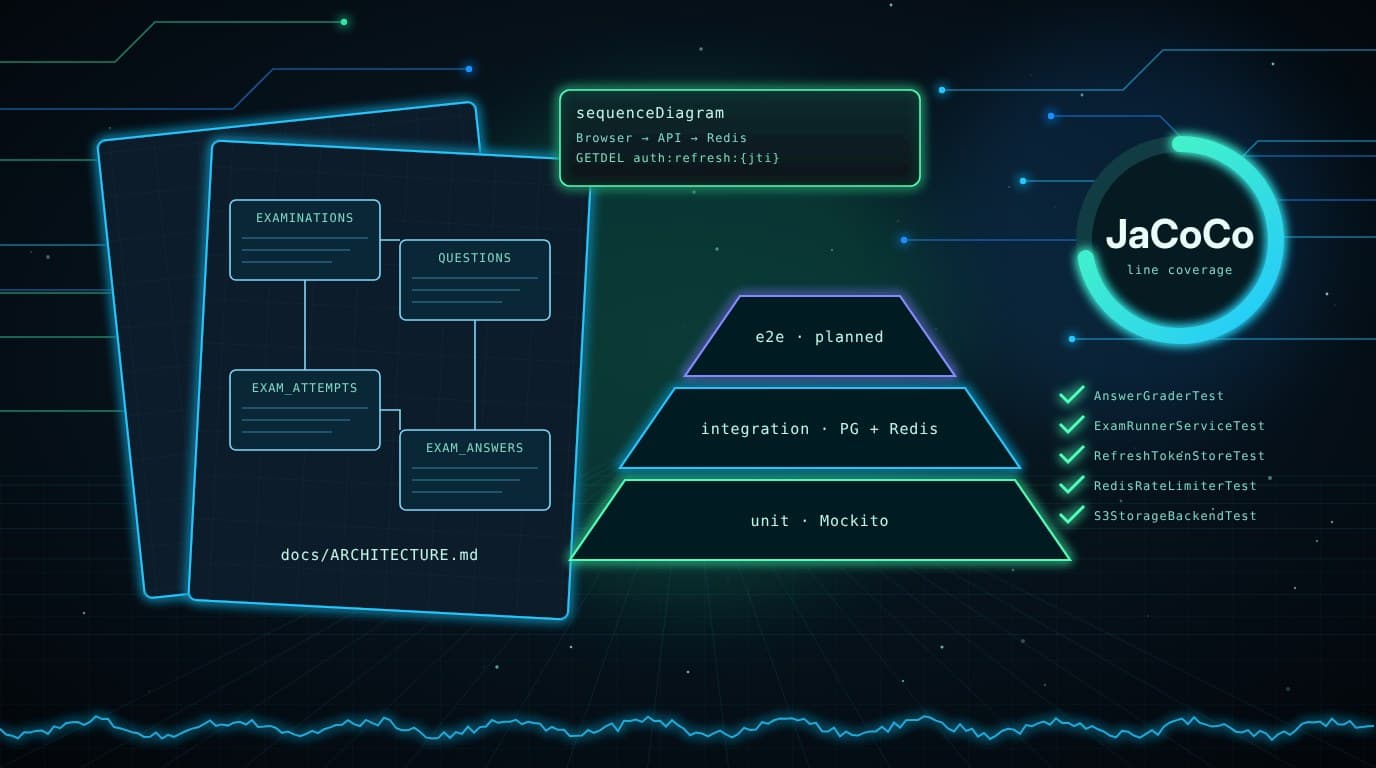
Introduction: When the README Stops Telling the Truth
After Part 5, Part 6 and Part 7, the code of mfarim/spring-elearning-react had changed a lot. My README, on the other hand, had barely changed. It still promised a "Redis cache", a STOMP broker "backed by Redis", and a "decoupled micro-architecture".
None of that was true. Redis held refresh tokens, the broker was Spring's in-memory simple broker, and the backend was a single Spring Boot service. I had even repeated the same "Redis cache" claim myself in Part 1 of this series.
The way I see it, inaccurate docs cost more than missing docs. A contributor plans work around a cache that doesn't exist. An interviewer asks how cache invalidation works, and the honest answer is "there is no cache". An operator scales out because "STOMP uses Redis", and teachers stop receiving live events.
In this final part I'll walk you through two pull requests:
- Pull Request #24: docs/architecture-accuracy: README claims corrected and a new
docs/ARCHITECTURE.md(316 lines). - Pull Request #25: feat/roadmap-hardening: the tests and the JaCoCo report that came with the changes from Parts 6 and 7.
Click the diagram to open it at full size.
1. Auditing the README Against the Code
I went through the README one claim at a time and checked each one against the source, the same way I audited the security code in Part 5:
| README said | The code actually does | Fixed text |
|---|---|---|
| "Redis cache" | No @Cacheable, no cache manager. Redis stores refresh-token jtis | "Redis-backed refresh-token rotation" |
| "STOMP message broker backed by Redis" | config.enableSimpleBroker("/topic", "/queue"), in memory | "in-memory simple broker" (Redis fan-out came later in PR #25, as an opt-in) |
| "decoupled micro-architecture" | One Spring Boot deployable with domain packages | "modular monolith with a separate React SPA" |
| Redis as "Session & Telemetry Broker" | Sessions are stateless JWTs; telemetry goes through STOMP | "Refresh-token store, rotation & revocation by jti" |
| Node 20 Alpine | Dockerfile uses node:22-alpine (since PR #6) | Node 22, Nginx 1.28 |
Project tree with learning/ module and config/ holding JWT | Packages are material/, announcement/, grade/, and a separate security/ | Tree regenerated from the real packages |
The fix was not to make the system sound smaller. It was to describe what it actually does, and to point to one place that explains why.
Rule I now follow: every architecture claim in a README should be checkable with a
grep. If "Redis cache" is written down,@Cacheableor aCacheManagermust exist somewhere.
2. What Goes Into docs/ARCHITECTURE.md
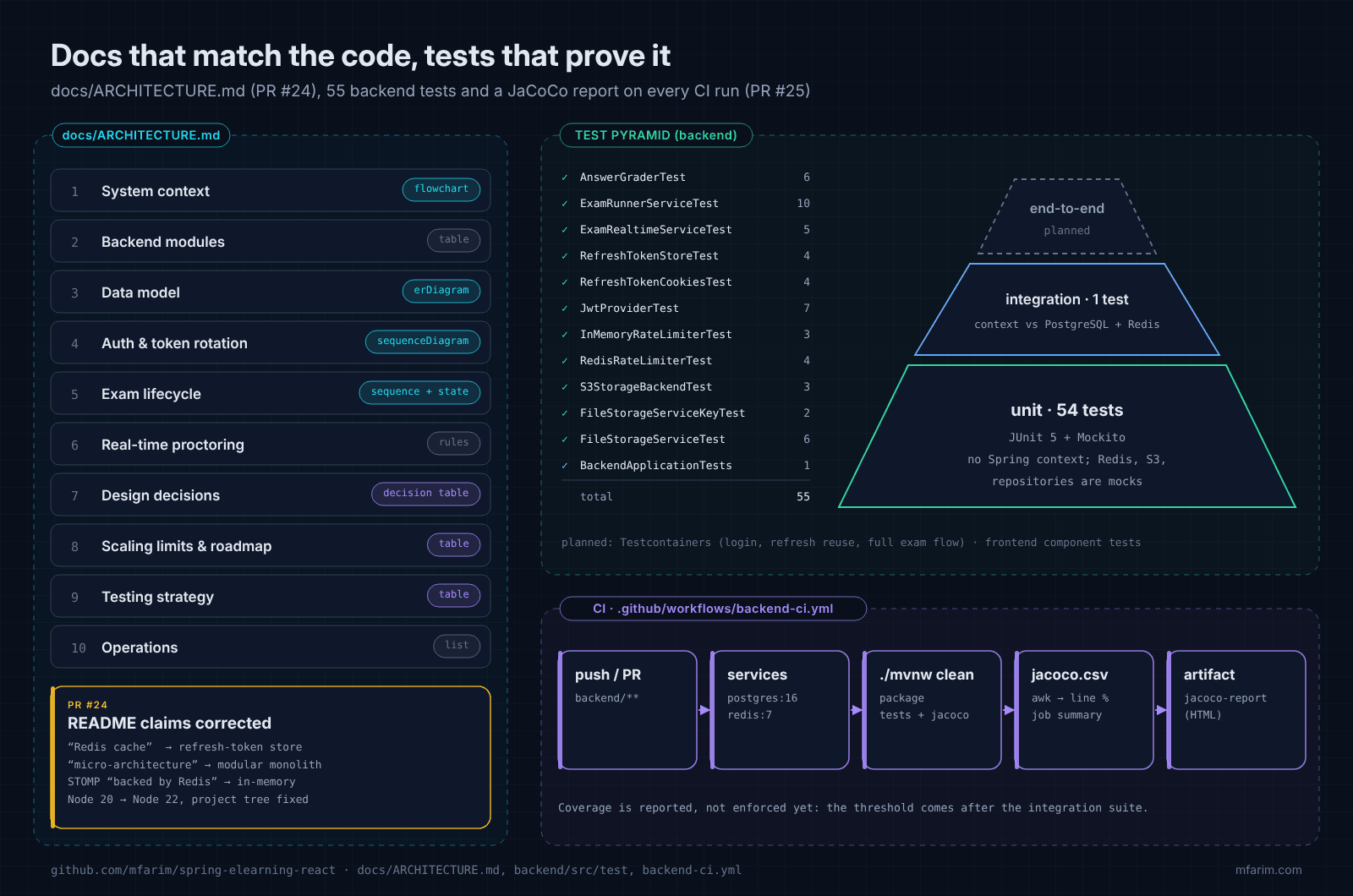
The README answers "what is this and how do I run it". docs/ARCHITECTURE.md answers "how is it built, why, and where does it break". I split it into ten sections:
| # | Section | Format | Question it answers |
|---|---|---|---|
| 1 | System context | Mermaid flowchart + table | What runs where, and who talks to whom? |
| 2 | Backend modules | Table | Where does a piece of logic belong? |
| 3 | Data model | Mermaid erDiagram | How are classes, exams, attempts and answers related? |
| 4 | Authentication and token rotation | Mermaid sequenceDiagram | What happens on login, refresh, reuse, logout? |
| 5 | Exam lifecycle | sequenceDiagram + stateDiagram-v2 | Which rules does the server enforce during an exam? |
| 6 | Real-time proctoring | Rules + delivery modes | Who may subscribe, and how do events reach the teacher? |
| 7 | Design decisions | Decision / alternatives / why | Why this and not the obvious alternative? |
| 8 | Scaling limits and roadmap | Settings table + open items | What changes with several instances, and what is still missing? |
| 9 | Testing strategy | Current vs planned | What is tested, at which level? |
| 10 | Operations | List | CI, deploy, health checks, background jobs, logs |
Diagrams as code
I drew every diagram in Mermaid, so GitHub renders them and they live next to the code in the same pull request. When a flow changes, the diagram changes in the same diff, and the reviewer sees both. Here's the system context today:
Decisions, with the alternatives you rejected
The most useful section for readers (and for me six months from now) is the decision table. Each row names the alternative I considered and why it lost:
| Decision | Alternatives considered | Why |
|---|---|---|
| Modular monolith | Microservices | One team and one deployable; domain packages keep boundaries clear and allow later extraction |
| Stateless JWT + refresh tokens in Redis | Server-side sessions; JWT without a store | Stateless hot path, while logout, rotation and revoke-all still work |
| Refresh token in an httpOnly cookie | Refresh token in localStorage | Not readable by injected scripts; scoped to auth endpoints with SameSite=Strict |
| In-memory STOMP + Redis pub/sub fan-out | STOMP broker relay (RabbitMQ / ActiveMQ) | Reuses Redis; no new broker to run |
| Background expiry job + optimistic locking | Finalize only when the student returns | Results on time; @Version keeps it safe across instances without a distributed lock |
| Server-side timing and grading | Trusting the client timer and answers | The client is untrusted |
| Docker Compose on a VPS behind Cloudflare | Kubernetes; managed PaaS | Low, predictable cost |
A decision without its alternative reads like a preference. With the alternative, it reads like a trade-off someone actually thought about.
Writing down the limits
I deliberately opened the scaling section with an uncomfortable sentence: the default configuration targets one backend instance. After that it lists what to switch for several instances (the three settings from Part 7) and what is still open:
LocalDateTimewith the server time zone;Instant/timestamptzin UTC would remove ambiguity across regions.- The access token lives in
localStoragefor 15 minutes; an in-memory token with silent refresh would close that gap. - Integration tests with Testcontainers for the full login and exam flow, and a frontend test suite.
- A later migration to Spring Boot 4.
Listing known limits felt risky in a portfolio project. In practice it shows the opposite of what I feared: that I know where the edges are.
3. The Testing Strategy
Before PR #25, my backend had three test classes: a context-load test, JwtProviderTest, and FileStorageServiceTest. Every rule I added in Parts 6 and 7 came with tests. The suite now has 55 tests in 12 classes:
| Class | Tests | What it protects |
|---|---|---|
AnswerGraderTest | 6 | Short-answer normalization, ` |
ExamRunnerServiceTest | 10 | Scoring, manual grading, deadlines, retries, expiry job |
ExamRealtimeServiceTest | 5 | After-commit delivery, Redis fan-out, fallback, malformed messages |
RefreshTokenStoreTest | 4 | Store, consume exactly once, wrong user, revoke-all |
RefreshTokenCookiesTest | 4 | Cookie attributes, clearing, body-to-cookie move |
JwtProviderTest | 7 | typ claim both ways, unique jti, known secret refused |
InMemoryRateLimiterTest | 3 | Capacity, separate keys, reset |
RedisRateLimiterTest | 4 | Shared counter, rejection, fail open, reset |
S3StorageBackendTest | 3 | Upload, download metadata, missing object |
FileStorageServiceKeyTest | 2 | Random names, absolute/backslash keys rejected |
FileStorageServiceTest | 6 | Path traversal, dangerous extensions |
BackendApplicationTests | 1 | Spring context starts against PostgreSQL and Redis |
Mock at the boundary, test the rule
54 of the 55 tests are plain JUnit 5 + Mockito, with no Spring context, and they run in seconds. The idea is simple: mock the infrastructure (Redis, the S3 client, JPA repositories) and test the rule for real.
For RefreshTokenStore, the rule is "a refresh token works exactly once". The test stubs Redis to behave like GETDEL (a value the first time, null after that) and checks the store's answer:
@Test
void aRefreshTokenCanBeConsumedExactlyOnce() {
    when(values.getAndDelete("auth:refresh:jti-1")).thenReturn("7").thenReturn(null);

    assertTrue(store.consume("jti-1", 7L));
    assertFalse(store.consume("jti-1", 7L), "a replayed refresh token must be rejected");
}
The fail-open decision from Part 7 is a rule too, so I gave it a test instead of a comment:
@Test
void failsOpenWhenRedisIsUnavailable() {
    when(redis.execute(eq(RedisRateLimiter.INCREMENT_SCRIPT), eq(List.of("rate:login:ip:1")), eq("60000")))
            .thenThrow(new RedisConnectionFailureException("connection refused"));

    assertTrue(limiter.tryAcquire("login:ip:1", 5, minute));
}
Testing "only after commit" without a database
The trickiest rule to test was "monitor events are sent only after the transaction commits". It turns out I didn't need a real transaction. Spring's TransactionSynchronizationManager can be driven by hand:
@Test
void insideATransactionTheEventIsSentOnlyAfterCommit() {
    TransactionSynchronizationManager.initSynchronization();

    service("local").broadcastExamEvent(7L, "EXAM_SUBMITTED", Map.of("score", 80));
    verifyNoInteractions(messaging);                 // nothing sent yet

    TransactionSynchronizationManager.getSynchronizations().forEach(TransactionSynchronization::afterCommit);
    verify(messaging).convertAndSend(eq(MONITOR), any(Object.class));
}
An @AfterEach clears the synchronization so tests don't leak state into each other.
Pure code needs no mocks at all
AnswerGrader from Part 6 has no dependencies, so its tests are just inputs and outputs. That was my main reason for pulling grading out of the service: the rules that decide a student's score should be the easiest code in the project to test.
Testing the bug, not just the feature
The tests I value most are the ones that reproduce the bugs from Part 6, so those bugs can't come back unnoticed:
@Test void savingAnAnswerAfterTheDeadlineFinalizesTheAttempt()          // the rollback bug
@Test void manualGradingKeepsAttemptPendingUntilEveryEssayIsGraded()  // partial grading shown as final
@Test void startCreatesTheNextAttemptNumberWhenRetriesAreAllowed()     // the retake crash
@Test void finalizeDoesNothingForAttemptsThatAreAlreadyFinished()      // double grading
What the unit tests can't prove
Mocks can't prove that the native SQL in findExpiredInProgressAttemptIds runs on PostgreSQL, that @Version really produces a conflict, or that the V3 migration applies cleanly to old data. For that I need a real database. The one integration test (contextLoads) runs against PostgreSQL 16 and Redis 7 service containers in CI, so Flyway applies V1 → V3 on every build, but a full flow test with Testcontainers is still on the roadmap. The docs say so.
4. JaCoCo Coverage on Every CI Run
I measure coverage with the JaCoCo Maven plugin. prepare-agent instruments the tests, and report runs in the test phase:
<plugin>
    <groupId>org.jacoco</groupId>
    <artifactId>jacoco-maven-plugin</artifactId>
    <version>${jacoco.version}</version> <!-- 0.8.12 -->
    <executions>
        <execution>
            <id>prepare-agent</id>
            <goals><goal>prepare-agent</goal></goals>
        </execution>
        <execution>
            <id>report</id>
            <phase>test</phase>
            <goals><goal>report</goal></goals>
        </execution>
    </executions>
</plugin>
The GitHub Actions workflow starts PostgreSQL and Redis as service containers, runs ./mvnw clean package, then turns jacoco.csv into a one-line summary on the job page and uploads the HTML report:
- name: Build and Package with Maven
  run: ./mvnw clean package

- name: Publish coverage summary
  if: always()
  run: |
    if [ -f target/site/jacoco/jacoco.csv ]; then
      awk -F, 'NR > 1 { missed += $8; covered += $9 }
        END { total = missed + covered; if (total > 0) printf "### Backend line coverage: %.1f%% (%d of %d lines)\n", 100 * covered / total, covered, total }' \
        target/site/jacoco/jacoco.csv >> "$GITHUB_STEP_SUMMARY"
    fi

- name: Upload coverage report
  if: always()
  uses: actions/upload-artifact@v4
  with:
    name: jacoco-report
    path: backend/target/site/jacoco
    if-no-files-found: ignore
Columns 8 and 9 of the JaCoCo CSV are LINE_MISSED and LINE_COVERED. if: always() publishes the numbers even when a test fails, which is exactly when you want to look.
Why there is no coverage threshold yet
JaCoCo can fail the build below a percentage. For now, I chose not to use that. Controllers and the Excel import code are still mostly untested, so any threshold today would either be meaninglessly low or block unrelated pull requests. My plan, written in the testing strategy table, is to add the threshold once the Testcontainers suite exists. Until then, the number is visible on every run, and a drop gets noticed in review.
5. The Whole Series in One Table
| Part | Topic | Pull requests |
|---|---|---|
| 1 | Rebuilding the Laravel monolith as Spring Boot + React | — |
| 2 | Path traversal, refresh tokens, Docker resilience | #1 |
| 3 | Stateless JWT, method-level RBAC, OWASP Top 10, rate limiting | #1, #3, #4 |
| 4 | Single VPS deployment with Docker Compose, Nginx and SSL | #2 |
| 5 | Second audit: real client IP, refresh rotation, forced password change, file and STOMP authorization | #5, #6 |
| 6 | Exam integrity: noRollbackFor, expiry job, unique attempts, @Version | #25 |
| 7 | httpOnly cookie, CSP, Redis and S3 for several instances | #25 |
| 8 | Architecture docs, testing strategy, JaCoCo | #24, #25 |
Conclusion
This series started as "rebuild a Laravel e-learning platform with Spring Boot and React". It ended up somewhere more useful: a system whose security, exam rules and scaling limits are written down, tested, and match the code.
If I had to keep just three habits from these eight parts, they'd be these:
- Audit with the attacker's knowledge. Assume they've already read your repo (Part 5).
- Let the database guarantee what
ifstatements can't. Unique keys, version columns and transaction boundaries (Part 6). - Make docs checkable. Every claim should be one
grepaway from the code that proves it (Part 8).
Thanks for following along all the way to the end. The code, the docs and the live demo are all public, so I'd love to see your issues and pull requests.
- Live demo: https://spring-elearning.mfarim.com
- Source code: github.com/mfarim/spring-elearning-react
- Architecture guide: docs/ARCHITECTURE.md
- Pull requests: #24, #25

Written by Muhammad Fari Madyan
Senior Full Stack Engineer and co-founder of LampungDev. I write up what I build so others can learn from it.